
On the morning of October 1, in Trung Son Ward, the Provincial Agricultural Extension Center organized a field seminar on the Senepol crossbred dual-purpose cow farming model and Senepol crossbred calf production.
The seminar was attended by representatives from the Department of Science and Technology, the Trung Son Ward Public Service Center, as well as local livestock farmers.
Ninh Binh Province has diverse terrain and favorable conditions for the development of large livestock farming. To promote the improvement and enhancement of the local cattle herd, the Provincial Agricultural Extension Center took the lead in implementing the project in collaboration with Minh Long Agriculture, Forestry, Tourism and Technology Transfer Trading Joint Stock Company.
The project, titled “Application of Technical Advances to Evaluate Reproductive Performance and Improve the Care and Nutrition Management Process for Senepol Crossbred Dual-Purpose Cattle in Ninh Binh Province,” aims to apply advanced technical solutions to improve cattle productivity and reproductive performance, while developing an effective and suitable farming process for local conditions.
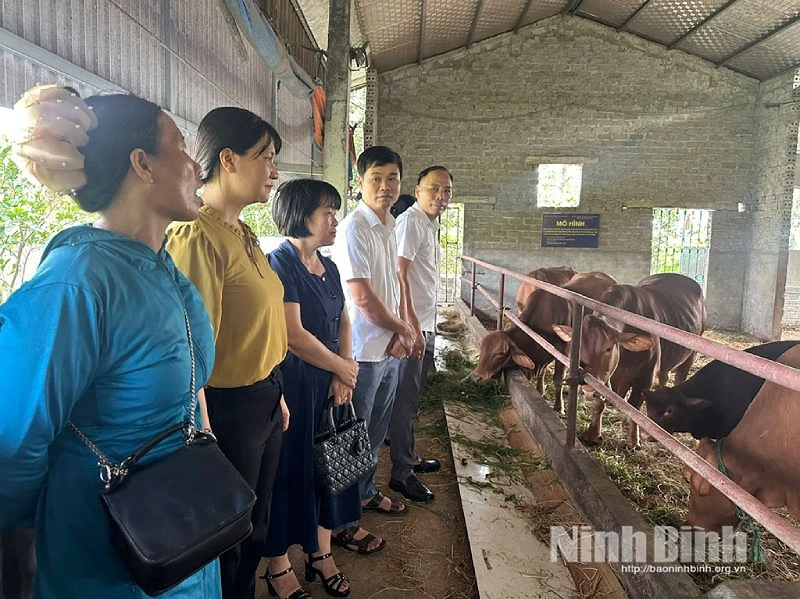 Delegates visit the Senepol crossbred cattle farming model at a local household in Trung Son Ward.
The model has been implemented from 2024 to 2027, with a total scale of 20 F1 Senepol crossbred cows (Senepol-crossbred sire × Zebu dam). On November 25, 2024, the Center handed over the breeding cattle to six participating households in three localities: Trung Son Ward, Yen Son Ward, and Khanh Nhac Commune. The breeding cattle met strict technical standards, were healthy, and were accompanied by complete quarantine certificates.
Throughout the implementation period, the crossbred cows and calves at all three sites have shown very good growth and development, adapted well to local conditions, had good feed intake, and experienced no outbreaks of infectious diseases. The survival rate of both cows and calves reached 100%. All cows were successfully bred and became pregnant. To date, the model has produced 16 healthy Senepol crossbred calves. The calves are naturally polled, have well-balanced body conformation, and gain weight rapidly. The average birth weight was 28.06 kg per calf, increasing to an average of 144.7 kg at six months of age and 192.2 kg at nine months.
At the seminar, technical staff and participating farmers shared their experience in caring for and feeding the cattle herd. Of particular note was the proactive provision of green roughage combined with concentrate feed containing at least 13% crude protein, along with mineral lick supplementation. Strict disease prevention measures were also implemented, including full vaccination, regular deworming, and periodic disinfection of cattle housing facilities.
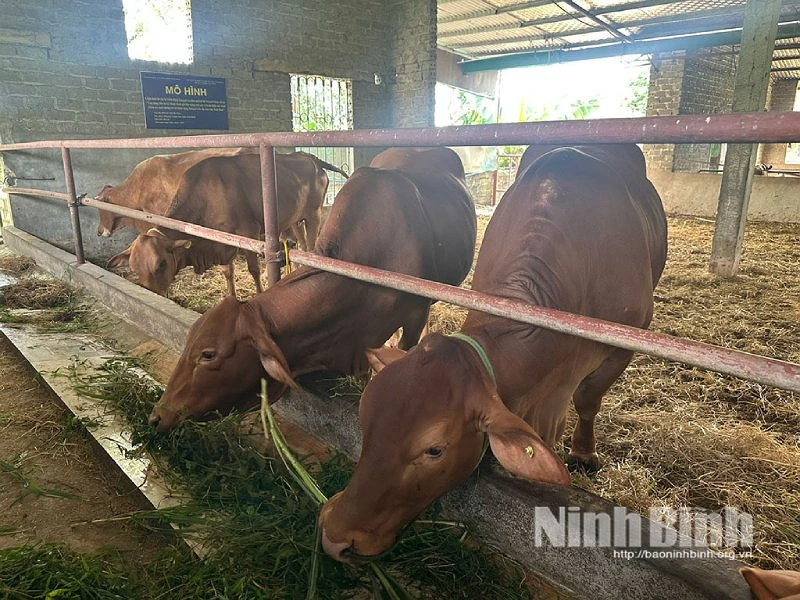 Senepol crossbred cattle are naturally polled or have poorly developed horns, are highly fertile, and have high meat productivity.
In terms of practical effectiveness, Senepol crossbred cattle offer many outstanding advantages, including early maturity, high fertility, good heat tolerance, strong foraging and grazing ability, good resistance to diseases, ticks and other parasites, while second-generation crossbred calves have a high meat yield and good meat quality.
According to the estimated economic efficiency (excluding labor costs), raising a crossbred calf to six months of age is expected to generate a profit of VND 8.86–10.12 million per calf after deducting expenses. If the calf is raised to nine months of age, each calf is expected to generate a profit of VND 13.91–15.91 million.
Assessing the results achieved, a representative of the Provincial Agricultural Extension Center recommended that participating households continue to closely follow the technical procedures and carefully monitor the reproductive performance of the breeding cows as well as the growth and development of the crossbred calves to ensure the highest possible economic efficiency. The initial success of the model opens up a promising new direction, helping local farmers increase their income and develop sustainable livestock production in the province.
Nguyen Luu
Source: Ninh Binh Newspaper